Back to List
Note: ①This article is compiled from online information; please use discretion. ②If any errors are found, corrections are welcome. ③For a more comprehensive and systematic understanding of geosynthetics, please refer to professional and authoritative materials for product information and application knowledge.
1. Common Manifestations and Hazards of Soil Erosion in Green Belts
Soil erosion in roadside green belts shows up on site in several ways:
- Rills and gullies on slopes. Rainstorms cut gullies of varying depth into the slope, stripping soil and leaving the surface uneven.
- Mud on the road and blocked drainage. Washed-down sediment piles on the pavement and in drainage ditches, making the road dirty and slippery and clogging outlets.
- Destroyed vegetation and low survival rates. Seedlings are washed down and roots exposed; newly replanted vegetation struggles to take root, with low survival rates.
- Undermined subgrade edges. Soil on the side of the green belt adjacent to the subgrade is washed away, leaving the road edge unsupported and creating a safety hazard.
- Dust and visual problems. Bare slopes generate dust when dry, and exposed yellow soil in green belts detracts from the urban landscape.
- Repeated replanting and high costs. Without slope protection, soil replacement and replanting are repeated year after year, and maintenance spending accumulates.
2. Causes of Soil Erosion
Erosion in green belts mainly stems from slope conditions, soil, protection, and maintenance:
(1) Steep and long slopes
Roadside green belts are often built as slopes; with steep gradients and long slope lengths, rainwater concentrates quickly and scouring force is strong.
(2) Loose soil and uncompacted backfill
Planting soil is loose and backfill is insufficiently compacted, so the soil has poor erosion resistance and disperses as soon as it rains.
(3) Lack of surface protection
Bare slopes without geotextile or vegetation cover let raindrops strike the soil directly, with nothing to block scouring.
(4) Improper drainage layout
Without longitudinal and transverse drainage measures, rainwater sheets across the slope and concentrates into gullies.
(5) Low vegetation survival and coverage
Seedlings fail to establish and lawns do not close, leaving the surface exposed for long periods with insufficient protection.
(6) Neglected maintenance
Insufficient soil replacement, replanting, pruning, and inspection allow small gullies to grow into large ones.
3. Role and Selection of Geotextile Protection
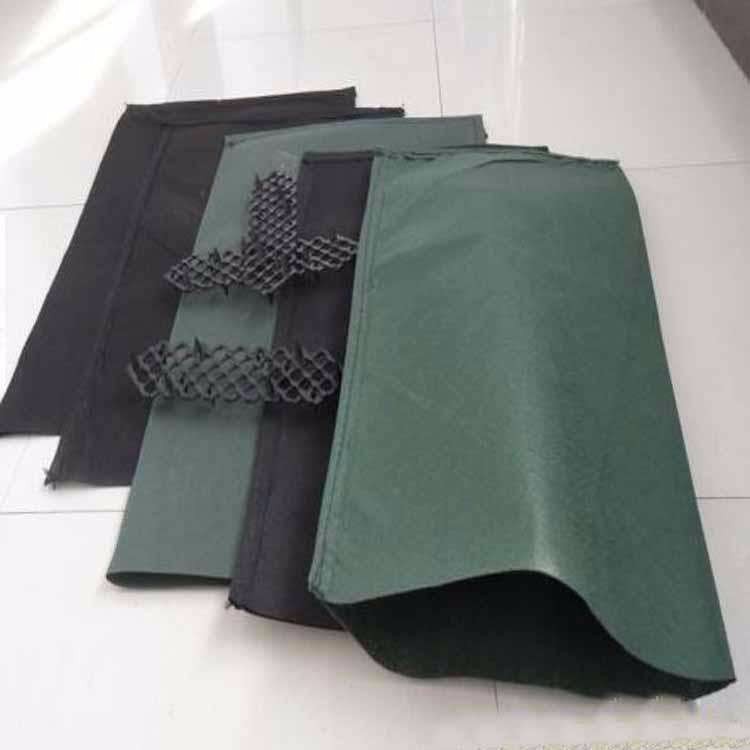
In green belt erosion control, geotextile serves to cover and protect, retain soil, and preserve moisture. For coverage, the fabric laid on the slope blocks direct raindrop impact, reduces flow velocity, and limits scouring; for soil retention, the surface restrains topsoil particles and prevents fine soil from being carried away; for moisture preservation, it reduces evaporation and creates conditions for vegetation establishment. For selection, gram weight is chosen according to slope gradient and scouring intensity: steeper slopes with stronger scouring use higher gram weights, while gentle slopes can use medium to low weights; aging resistance and UV resistance must also be considered for long-term exposure. Geotextile works together with vegetation: protect first, then plant, for more stable results.
4. Common Construction Pitfalls
Several pitfalls in green belt protection can defeat the treatment:
- Planting without protection. Planting seedlings on bare slopes means one rainstorm washes them out and replanting repeats.
- Choosing geotextile that is too thin. Insufficient gram weight gives poor scouring resistance, and the fabric tears in heavy rain.
- Insufficient overlap and anchoring. Overlaps too narrow and no fixing at the crest and toe let rainwater break through the seams.
- Uneven laying that does not hug the slope. Bridging and wrinkling allow rainwater to channel under the fabric, defeating protection.
- No edge burying or weighting. Edges not buried or secured are lifted by wind and washed away, displacing entire sections.
- No maintenance during the establishment period. Without inspection and patching, local damage expands into large-scale failure.
5. Common Concerns of Municipal Maintenance Units
For green belt treatment projects, maintenance units typically worry about:
- Repeated annual repairs. Incomplete treatment means gullies return after every rainstorm, turning recurring orders into rework.
- Landscape impact. Conspicuous geotextile detracts from the green belt's appearance and may fail acceptance.
- Material durability. Fabric ages and tears after sun and rain, failing within a year or two.
- Conflict with vegetation. The fabric may hinder seedling growth and lawn emergence.
- Schedule conflicts with maintenance operations. Roads cannot be closed for long, leaving limited construction windows.
- Unclear responsibility. When protection, planting, and maintenance are contracted separately, problems lead to disputes.
These concerns are addressed through matched materials, standardized construction, and turnkey contracting.
6. Overall Treatment Technical Solution
Green belt erosion control should proceed systematically, step by step:
(1) Site survey and zoning
Survey gradient, slope length, soil, erosion severity, and drainage conditions along each section; zone by scouring intensity to determine protection levels and material specifications.
(2) Slope preparation and soil treatment
Clear gullies, level the slope, loosen and amend soil, and compact backfill in layers to form a stable slope surface.
(3) Drainage layout
Set longitudinal and transverse drainage ditches and outlets according to the slope, guiding rainwater out in an orderly way to avoid sheet flow.
(4) Geotextile installation and anchoring
Lay geotextile to the slope shape with a flat, hugging surface and adequate overlap; bury and anchor edges at the crest, toe, and sides to prevent displacement.
(5) Vegetation restoration
Plant seedlings or lay turf through openings in the fabric or with degradable protection, choosing adapted species to ensure survival and coverage.
(6) Maintenance period management
Arrange inspection, soil replacement, replanting, and pruning after treatment, repairing local damage promptly to consolidate results.
(7) Acceptance
Accept the slope flatness, protection coverage, drainage flow, and vegetation coverage per design and specifications, with records retained.
7. Value of Turnkey Material-and-Labor Contracting
Green belt treatment is a recurring maintenance type of project, making turnkey contracting a reliable approach:
- Integrated plan. Survey, slope preparation, drainage, protection, and vegetation are coordinated by one party, so protection and planting are not disconnected.
- Matched materials. Geotextile gram weight is selected by slope conditions, with aging resistance meeting local climate requirements.
- Standardized construction. Laying, overlapping, and anchoring follow specifications, with records kept for concealed works.
- Controllable schedule. Construction is organized around road maintenance windows, reducing impact on traffic and landscape.
- Single point of responsibility. The contractor is responsible for treatment results and follows up when problems appear after rainstorms.
- Lower total cost. Doing it right once reduces repeated soil replacement and replanting in recurring orders.
Soil erosion in roadside green belts has its root in slope protection and drainage layout. Leveling and compacting the slope, organizing drainage, laying and anchoring geotextile properly, restoring vegetation, and maintaining thereafter are what actually stop erosion.