Back to List
Note: ①This article is compiled from online information; please use discretion. ②If any errors are found, corrections are welcome. ③For a more comprehensive and systematic understanding of geosynthetics, please refer to professional and authoritative materials for product information and application knowledge.
1. Secondary Water Quality Problems Caused by Seepage Barrier Damage
Damage to the seepage barrier in a wetland park often causes water quality problems that are more troublesome than the leakage itself:
- Water level hard to maintain. Water continuously seeps through the damaged barrier, requiring frequent replenishment; in dry seasons the wetland may even dry up and expose the bottom, ruining the landscape effect.
- Polluted water upwelling from the bottom. Damaged spots become exchange channels between water layers, allowing bottom water with high salinity, high nutrients, or pollutants to enter the upper water body and deteriorate water quality indicators.
- Aggravated eutrophication. Nutrients enter the water body through seepage exchange, algae multiply, water turns green and transparency drops.
- Surrounding pollution infiltrating. Damaged spots also serve as channels for external sewage and agricultural return flow, turning the wetland into a pollution collection area.
- Secondary pollution from sediment and water. Long-term seepage exchange changes sediment properties and releases pollutants, causing repeated water quality deterioration.
- Rising treatment costs. Treating water quality without repairing the barrier leads to repeated deterioration, with continuous spending on water replenishment, exchange, and chemical dosing.
2. Causes of Seepage Barrier Damage
Damage to the wetland seepage barrier mainly originates in materials, construction, and later maintenance:
(1) Improper geomembrane selection
Thin membranes or insufficient raw material performance provide poor puncture resistance and aging resistance, making damage likely under complex wetland conditions.
(2) Inadequate base preparation
Stones, roots, or construction debris left in the base puncture the membrane after laying; an uneven base causes the membrane to bridge and concentrate stress.
(3) Poor welding quality
Improper control of welding temperature and speed leads to weak or missed welds, which become seepage channels.
(4) Rough node treatment
Nodes such as shorelines, inlet and outlet structures, pipe penetrations, and partition dikes are not reinforced, allowing water to seep around them.
(5) Mechanical damage during construction
Backfilling, soil covering, and lifting operations cause rolling and scratching, leaving hidden membrane damage that is invisible at the time.
(6) Lack of later maintenance
Root penetration by aquatic plants, human trampling, and dredging operations continuously create new damage during operation.
3. Role and Selection of Composite Geomembrane
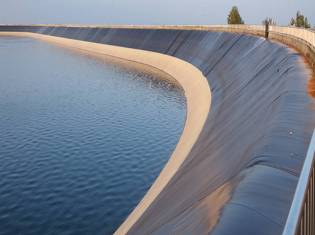
A composite geomembrane combines a geomembrane layer with a geotextile layer: the membrane blocks seepage while the fabric provides protection, making it suitable for wetland conditions. The membrane layer blocks downward seepage and exchange between water layers, cutting off the channel for secondary water quality problems at the source; the fabric layer buffers puncturing from sharp objects in the base and plant roots, improving damage resistance and improving friction behavior on the membrane surface. For selection, membrane thickness is determined by water depth, base conditions, and planting configuration, with thicker specifications in deep-water zones and areas with dense roots; the membrane-fabric combination is matched to puncture and tensile requirements; and material environmental performance must meet ecological wetland requirements without introducing harmful substances. Selection is about matching working conditions, not simply choosing the thickest option, with weak points reinforced.
4. Common Construction Pitfalls
Several pitfalls in wetland seepage barrier construction easily leave hidden defects:
- Choosing thin membranes to save money. Thin membranes have poor puncture resistance; with complex roots and base conditions in wetlands, damage risk is high and later repair costs are large.
- Laying directly without cleaning the base. Uncleaned stones and roots puncture the membrane right after laying, and seepage control fails from the start.
- Uncontrolled welding temperature and speed. Rushing work by increasing welding speed with unstable temperature leaves weld quality unguaranteed, and leakage appears at the welds.
- No reinforcement at nodes. Without reinforcement at inlets, outlets, penetrating pipes, and shoreline connections, water seeps around nodes.
- Covering soil without acceptance testing. Without weld testing and damage inspection, hidden problems cannot be found after soil covering.
- Careless trampling during planting. Tools and roots damage the membrane when aquatic planting and landscape work proceed carelessly on the membrane surface.
5. Common Owner Concerns
Owners of wetland seepage repair projects typically have these concerns:
- Whether damage points can be located. Leakage locations are hidden, blind excavation fails to find the source, and repairing one spot leaks another.
- Whether water quality problems recur. Treating water quality without repairing the barrier brings temporary improvement, followed by rapid deterioration.
- Whether materials are environmentally safe. Wetlands are ecologically sensitive; substandard environmental performance affects aquatic organisms and landscape effects.
- Whether repair disrupts opening. Wetland parks have visitor and operation schedules, and long repair periods affect normal opening.
- Unclear responsibility. When inspection, materials, construction, and water quality repair are contracted separately, disputes arise when problems recur.
These concerns are resolved through systematic inspection, matched materials, and turnkey contracting.
6. Overall Treatment Plan
Seepage barrier damage and secondary water quality problems in wetlands should be treated systematically, step by step:
(1) Damage inspection and water quality diagnosis
First conduct a barrier integrity inspection, locating damaged areas through zoned water level observation and leakage detection; simultaneously test water quality indicators to identify pollution sources and severity, and determine whether the primary issue is the barrier or the water quality.
(2) Scheme design and material selection
Based on inspection results, determine the repair scope, composite geomembrane specifications, and node reinforcement scheme, while formulating supporting water quality measures so seepage control and water quality are designed together.
(3) Old membrane removal and base preparation
Remove damaged old membrane and debris in the repair area, level the base, clear sharp stones and roots, and lay a protective cushion where necessary to prepare for new material installation.
(4) Composite geomembrane installation and welding
Install the composite geomembrane as designed, with a flat surface and proper tension; control welding temperature and speed per process parameters, and use dual-seam testing to ensure sealing.
(5) Node reinforcement
Reinforce nodes such as shorelines, inlets and outlets, pipe penetrations, and partition dikes with additional layers and sealing treatment to eliminate seepage paths.
(6) Supporting water quality restoration
After seepage repair, carry out sediment treatment, aquatic plant adjustment, aeration or circulation measures to restore the water body's self-purification capacity and consolidate water quality improvement.
(7) Acceptance and operation maintenance
Conduct water storage tests and weld inspection to confirm effective seepage control; establish operation and maintenance requirements, control root penetration and limit heavy loads on the membrane surface, and conduct regular inspections to prevent new damage.
7. Value of Turnkey Material-and-Labor Contracting
Wetland seepage control and water quality treatment are closely linked, making turnkey contracting a reliable approach:
- Integrated plan. Inspection, design, materials, construction, and water quality measures are coordinated by one party, so seepage control and water quality are not disconnected.
- Matched materials. Composite geomembranes are selected by working conditions, with specifications and performance consistent with the repair scheme, without substitution of inferior products.
- Standardized construction. Base preparation, installation and welding, and node reinforcement follow specifications, with records kept for concealed works.
- Controllable schedule. Material supply and site construction are coordinated, keeping the repair period controllable and reducing impact on park operations.
- Single point of responsibility. The contractor is fully responsible for seepage control and water quality improvement, avoiding multi-party coordination when problems recur.
- Lower total cost. Fixing it right once avoids repeated inspection, water replenishment, and chemical dosing, keeping long-term investment more controllable.
Secondary water quality problems caused by seepage barrier damage in wetland parks have their root in the barrier and show up in water quality. Only by locating damage points through inspection, matching materials to working conditions, controlling welds and nodes during construction, and adding water quality measures after repair can the problem be solved once and for all.